In response to the Scottish Parliament’s recent motion for another independence referendum, SES Principal Investigator Prof. Ailsa Henderson investigates where public attitudes to the “mandate” question lie.
When we asked people in October 2023 why there had not been more progress towards independence, more than three quarters of respondents said it was because the UK government had not agreed to another referendum. On this, both Yes and No supporters agreed. But asked whether it was because the SNP had not pushed very hard for another referendum there were both lower levels of agreement (38%) and different views between Yes and No supporters. Fewer than 3 in 10 No supporters blamed – or more accurately, rewarded – the SNP for a lack of action, but more than half of Yes supporters cited this as a fairly or very important reason. Presumably it is this portion of the Yes-supporting electorate that yesterday’s motion was designed to reassure.
The different answers, and different levels of agreement, reflect the constitutional reality for the Scottish Government, something that remains unchanged by the motion. The 2022 Supreme Court ruling clarified that the Scottish Parliament does not have the legislative competence to call for and organise a secession referendum without permission to act outside its competence (via a Section 30 order). Notwithstanding this obvious fact, the political reality is that the Scottish electorate as a whole believes that it should be in Scottish Government’s gift to call for the Scottish Parliament to approve such a referendum. Based on a question from our June 2025 Scoop survey on whether the UK or Scottish Government should have the authority to call another independence referendum, a slim majority, and 54% of those with a view, believe it should be for the administration in Edinburgh to call one.
Obviously views on who has a right to call a referendum are highly polarised. The majority view among No supporters (56%) is that there should never be another referendum, and therefore it doesn’t matter who, technically, has the power to call one. The majority view among Yes supporters (95%) is that it should be for the Scottish Government to call, and enough No supporters believe this (11%) that it provides majority support within the electorate.
Equally relevant is that the SNP government is doing this in the shadow of an election. In some ways the 2021 and 2026 elections were fought on common ground, both on whether the SNP could achieve an outright majority to proceed with another referendum. The difference is that the 2026 campaign was fought after the Supreme Court judgement which rather changed the terms on which one might reasonably have expected a majority to automatically result in a referendum. Adding in UK government pronouncements that another referendum should not be forthcoming further muddied the waters.
Polarised views on who has a right to call a referendum coexist with polarised views about whether elections deliver mandates to call referendums. Yes supporters tend to think there is already a mandate to call one, No voters, again, believe nothing can confer a mandate. As a result there is a small slice of the electorate that believes election results confer mandates (20%), based on our 2026 pre-election survey data. Within this context, around half believe that a pro-indy majority – as compared to an outright SNP majority – confers a mandate.
When the Scottish Government introduced the motion, it was likely in the knowledge that a) the Scottish electorate in general supported their right to call one b) Yes supporters believed that a lack of SNP action was partly to blame for lack of progress and c) a pro-indy majority provided, for a portion of the electorate, the added impetus to act. These are the political realities of the motion.
The text of the motion “recognises that the people of Scotland have returned the largest pro-independence majority ever elected to the Scottish Parliament; believes this majority affirms a clear mandate that decisions about Scotland’s future are best taken in Scotland and that mandate must be respected”.
It is undeniably true that this was the largest ever pro-indy majority by seats (just). By votes, the combined SNP + Green total for list support was higher in 2011 (44+4.4 = 48.4) in 2016 (41.7+6.6 = 48.3) and in 2021 (40.3+8.1 = 48.4) than it was in this election (27.2+ 14 = 41.2). It is less obviously the case that the pro-indy majority of seats alone confers a clear mandate. Half of the twenty percent who believe elections deliver mandates would interpret it as such.
Equally relevant is why people chose to cast their ballots. In 2021, 90% of those with a constitutional preference backed a party with that same constitutional preference. This dipped in the 2024 UK general election, as many independence supporters backed Labour as a route to removing the Conservatives from office. Thus far it looks as if we are back in the region of 90% alignment between constitutional preferences and vote choice.
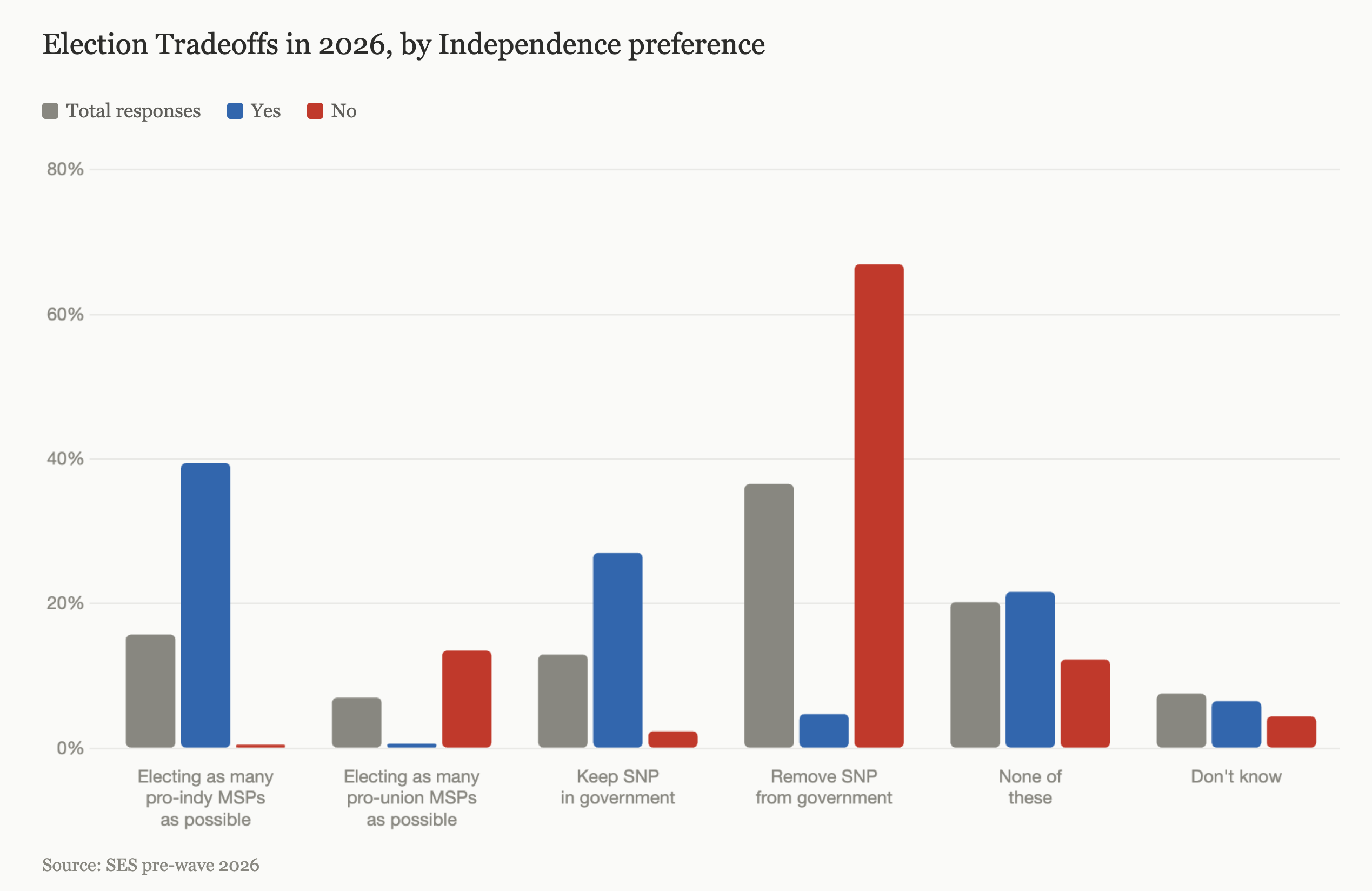
Less clear is whether the intention was to send a constitutional message with one’s vote. Asked before the election whether they intended to send a constitutional message or select a government, most responses were selecting a government. Indeed, most were seeking to remove the SNP from office. In part this is because a clear majority of No supporters were hoping to remove the SNP, and a further tranche were hoping to maximize the number of pro-union MSPs in Holyrood. Read from this perspective, it does not look as if the Scottish electorate’s decisions were designed to deliver a mandate to secure a further independence referendum.
This is, perhaps, a frustratingly academic ‘on the one hand they did, on the one hand they didn’t’ answer but it’s precisely this sort of nuance that an analysis of public opinion polling is supposed to inject into public debate.