

The SES’s Scottish Opinion Monitor polling series has run three times annually since December 2021, starting six months after the last Scottish Parliament election. Known affectionately as the Scoop, there are now 13 editions of the poll stretching back four years (plus a two-wave 2024 General Election panel survey), providing a rich time series on the state of public opinion throughout the turbulent life of the sixth parliamentary session since devolution. Fieldwork was carried out online by YouGov via active quota sampling of residents of Scotland aged 16-and-over, with samples of approximately 1,250, increasing to approximately 1,500 from February 2026 inclusive.
That February 2026 Scoop was the last one before the Holyrood election in three weeks’ time. As the campaign approaches peak intensity ahead of polling day, now is a good time to take stock of how we got here and consider the public mood going into the election. Are Scots happy with the direction of the country compared to five years ago, and which issues are motivating their choices? Why is an unpopular incumbent government still the favourite to win? And are there clues in the data which point to a possible surprise result?
Here we address three major themes, drawing on the time-series visualisations we regularly update on our Public Opinion Dashboard as well as new analysis. Firstly, we examine attitudes on the state of the country, politics and democracy in general. Fair warning: it’s not optimistic reading. Secondly, we look at opinions about the political parties and how vote intention has evolved since the last election, including the emergence of a new challenger in Reform UK. Finally, we reflect on constitutional attitudes and the resilience of support for Scottish independence despite the SNP’s challenges and the election of a Labour government at Westminster.
Some State
In every Scoop survey, we ask respondents about the direction they think the country is heading, with five options ranging from “completely the right direction” to “completely the wrong direction”. When we group the “completely” and “mostly” answers together, as shown in Figure 1, we see a very clear overall trend towards pessimism. The first Scoop survey in December 2021 was the only one in which “right direction” responses outnumbered “wrong direction” responses. This took place right at the end of the COVID-19 pandemic, with the main vaccination programme complete and families returning to a normal Christmas. It is perhaps unsurprising that there was a bit more optimism in the air at that point in time.
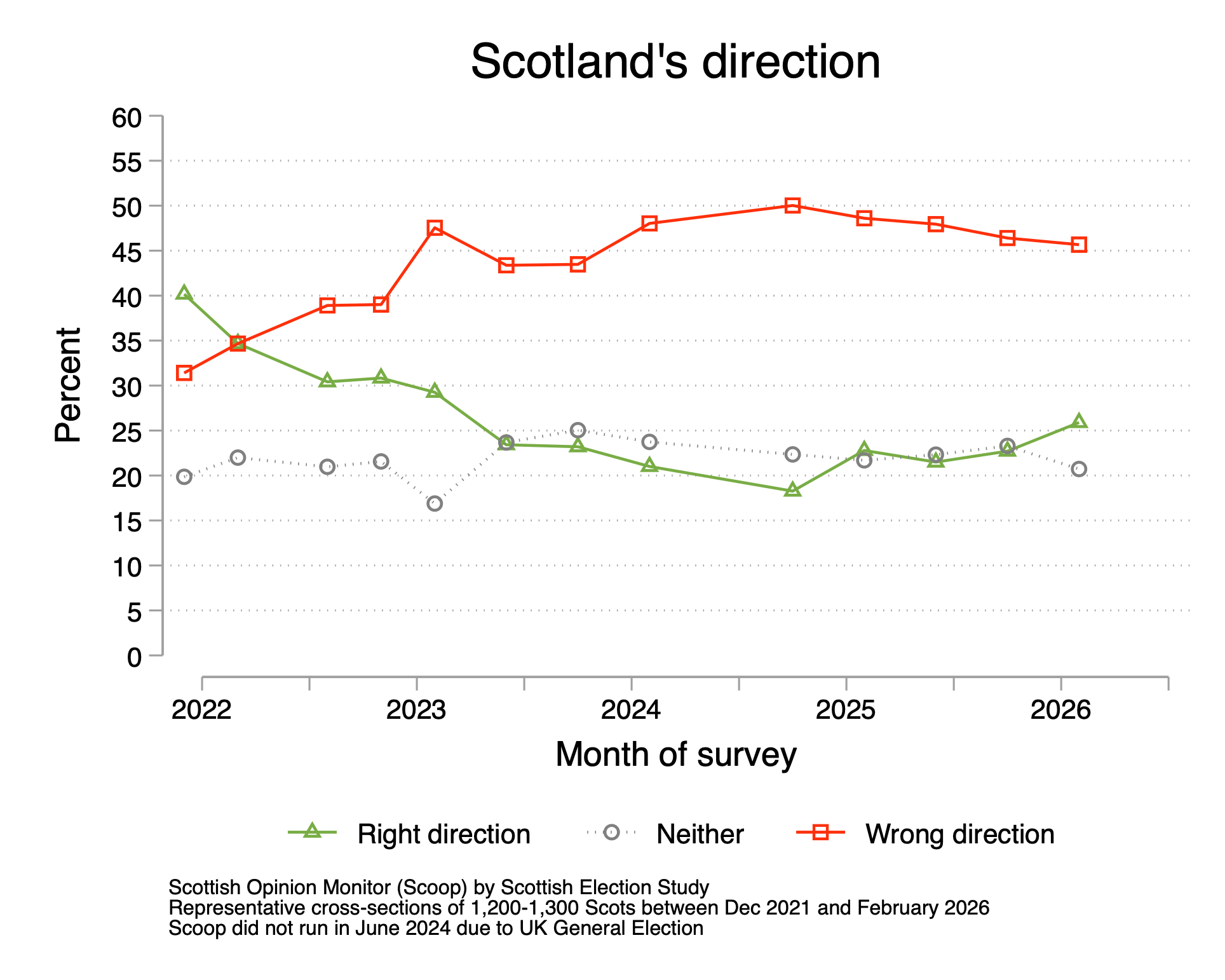
However, the mood soured quickly as the second-order effects of the pandemic and the public health policy response filtered through into the cost of living via inflation and increased pressure on the health service. By mid-2022, there was a clear net-negative assessment of the state of the country. That declined further in 2023, coinciding with Nicola Sturgeon’s resignation as First Minister, the SNP’s subsequent party finance scandal and a hostile leadership contest between Humza Yousaf and Kate Forbes. Evaluations of the country’s overall direction continued to slide through yet another change of leader immediately before the 2024 General Election, hitting their nadir in October 2024 with fewer than 20% of Scots believing things were going well. There has since been a modest uptick, with the gap between right and wrong direction closing a net 10 points, but it’s fair to say the overall outlook remains quite pessimistic.
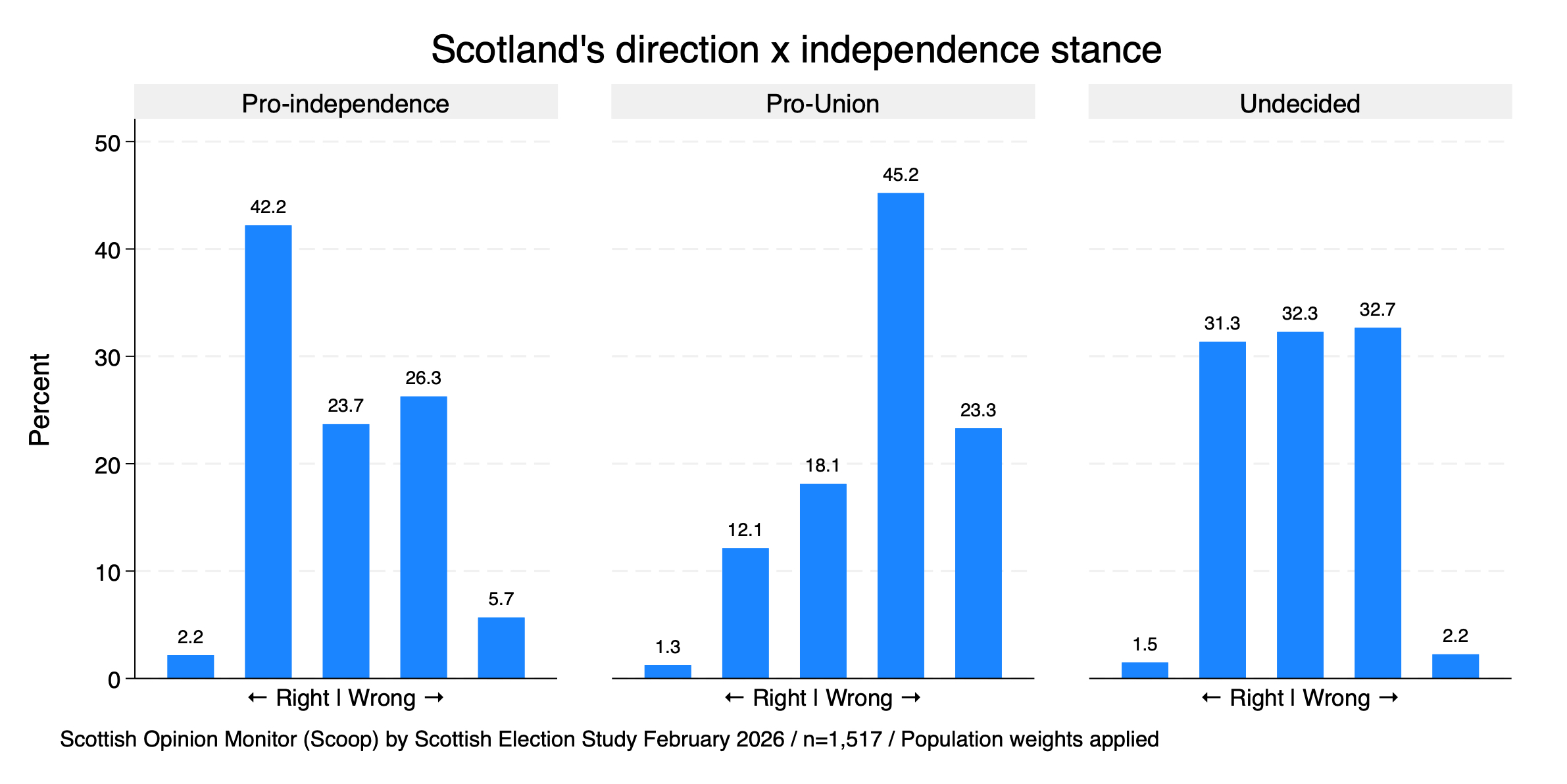
Importantly, assessments of whether the country is going in the right direction depend to some extent on people’s constitutional views. Figure 2 shows responses to the question from February 2026 broken down by respondents’ views on independence. The undecided group are very evenly split between “mostly the right direction”, “neither the right nor wrong direction” and “mostly the wrong direction”. Pro-union Scots are by far the most pessimistic in outlook, with 45% saying “mostly” the wrong direction and a further 23% saying “completely”. A plurality of pro-independence Scots, meanwhile, remain positive about the country’s direction. However, just 2% believe the country is going “completely” in the right direction, while a total of 32% combined think things are going in the wrong direction.
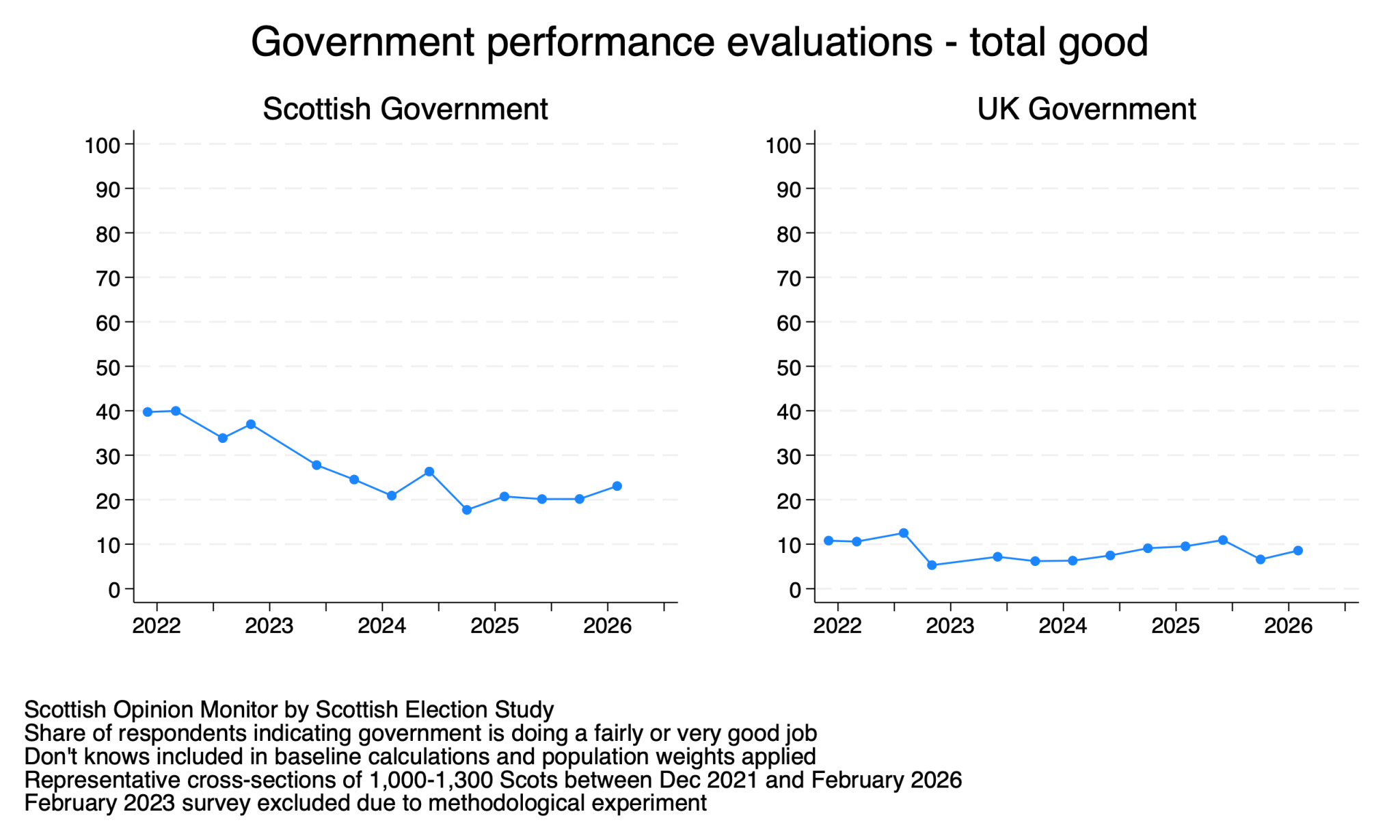
Evaluations of the country’s direction are very closely tracked by Scottish Government performance ratings. In Figure 3 below, we show responses to questions about whether the UK and Scottish Governments are doing a “good” or “bad” job. Once again, the response options for these are in five categories, and here we show just the share who regard each government as doing a good job overall.
UK government approval ratings always struggled to reach double figures, and even after Labour’s victory in 2024 (after which we updated the question wording) these “good” numbers hardly budged. It is worth noting that the share of responses in the “very bad” category fell from 56% to 29% between the February and October 2024 Scoops, with increases in the share saying “don’t know” and “neither good nor bad”, suggesting that people were willing to wait and see how Labour performed. However, the combined “bad” share for the UK Labour government increased from 51% just after they came to power to 67% in February 2026.
The Scottish Government, meanwhile, started out on a relatively healthy 40% “good”, but that gradually slid to around the 20% mark by 2024. John Swinney’s tenure as First Minister has seen that number stabilise but not meaningfully increase. These figures would be grim reading for any incumbent government. Yet just a couple of weeks out from polling day, the nationalists appear to be on course to win a 5th consecutive Holyrood election. It is often observed that the Scottish Government benefits from comparison with Downing Street, and this dynamic seems to persist.
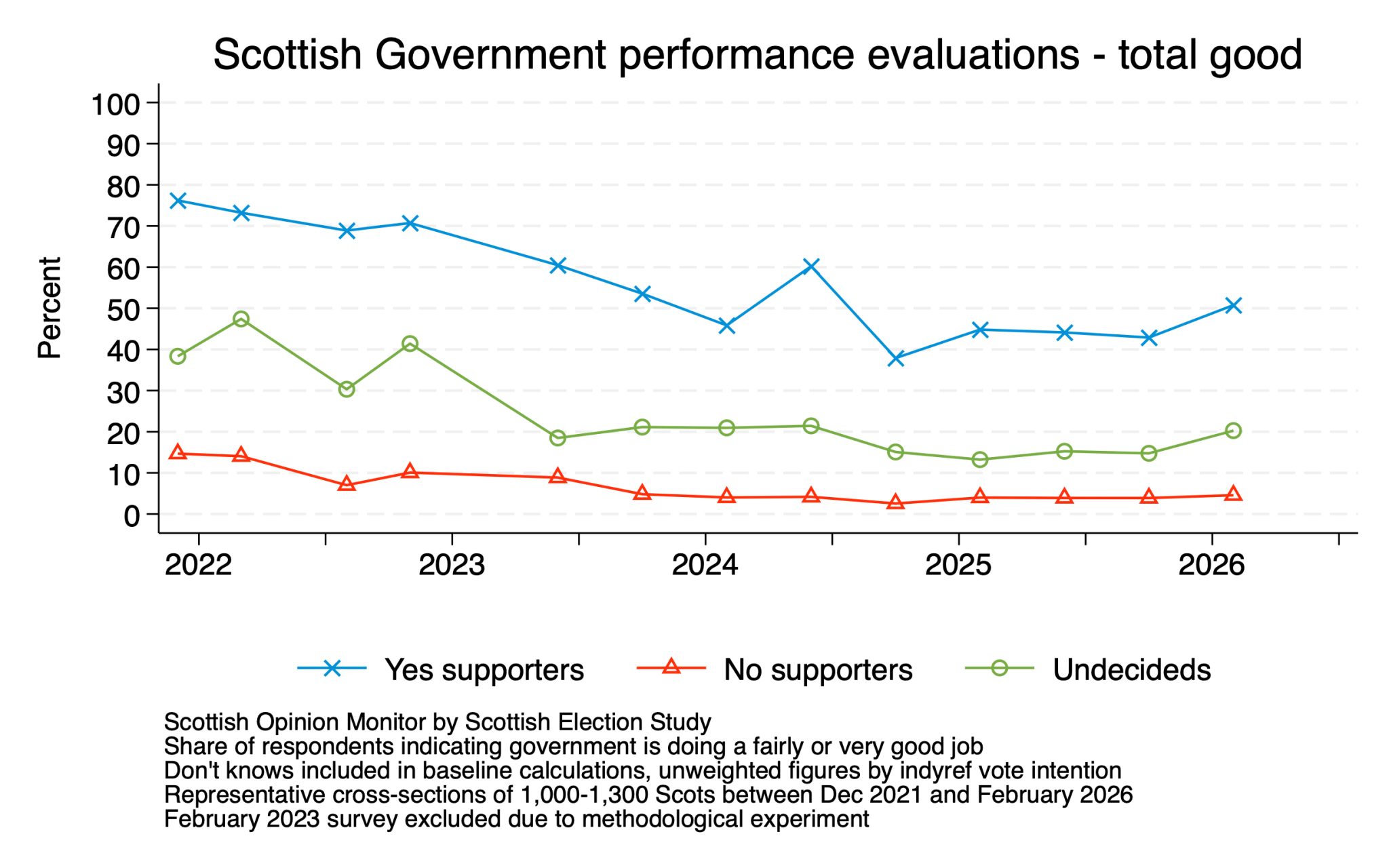
Interestingly, the decline in Scottish Government approval was largely driven by the changing attitudes of the SNP’s own core voters. Figure 4 breaks down the Scottish Government figure by respondents’ constitutional preferences at each given point in time. At the beginning of the term, more than three quarters of pro-independence Scots approved of the Scottish Government. That had almost halved by 2024 to below 40% and has subsequently risen back to around 50%. The administration also saw a decrease in support from the constitutional “don’t knows”, which typically represent around 10% of each sample. And any residual approval from anti-independence voters, which sat in the mid-teens in 2021, had completely evaporated by the middle of the parliament.
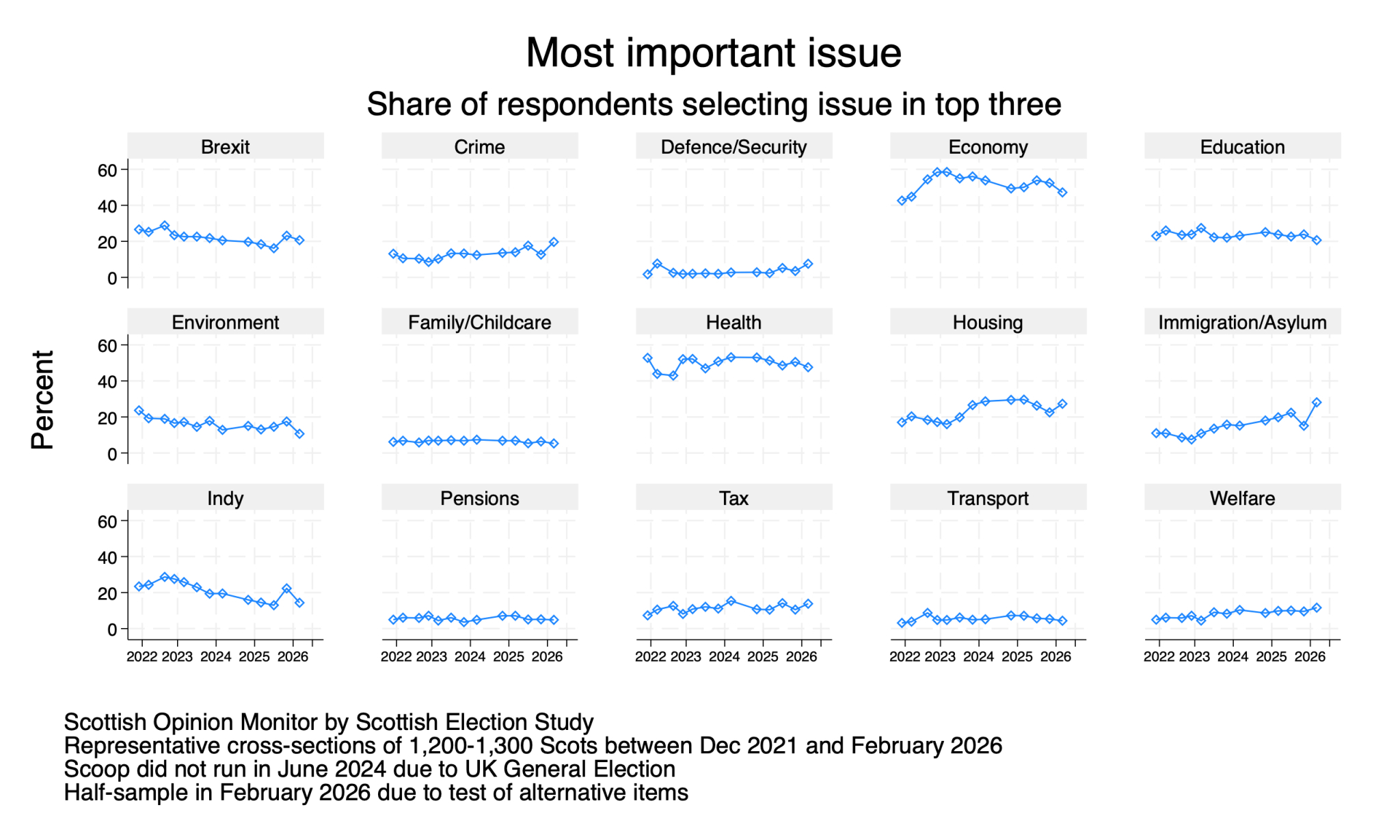
Before moving onto the electoral horse race, we review trends in the Scoop’s “most important issue” question, shown in Figure 5. Respondents are asked to choose the top three of 15 set policy issues in each Scoop. The economy and healthcare remained the most commonly selected, with around half of respondents picking these in each survey. Concern about the environment and Brexit steadily decreased, as did independence, phrased in the questionnaire as “Scotland’s constitutional future”. Housing crept steadily up to become one of the top issues, and concern about immigration and asylum also increased substantially over the period. It’s clear that voter priorities have shifted from the constitutional issues that dominated the 2010s toward bread and butter issues.
Here comes a new challenger
The major story of this election, assuming there is no late collapse in SNP support, is really the battle for second place. In 2021, the Scottish Conservatives narrowly beat Scottish Labour to this dubious honour, but it had little impact on the parliamentary arithmetic. This time, there are at least two and probably three parties vying for the runners up spot. And one of them has eaten the Conservatives’ lunch to such an extent that the Tories are now a toss-up for last place alongside the Scottish Lib Dems, who are increasingly focused on hyper-localised campaigns in rural constituencies.
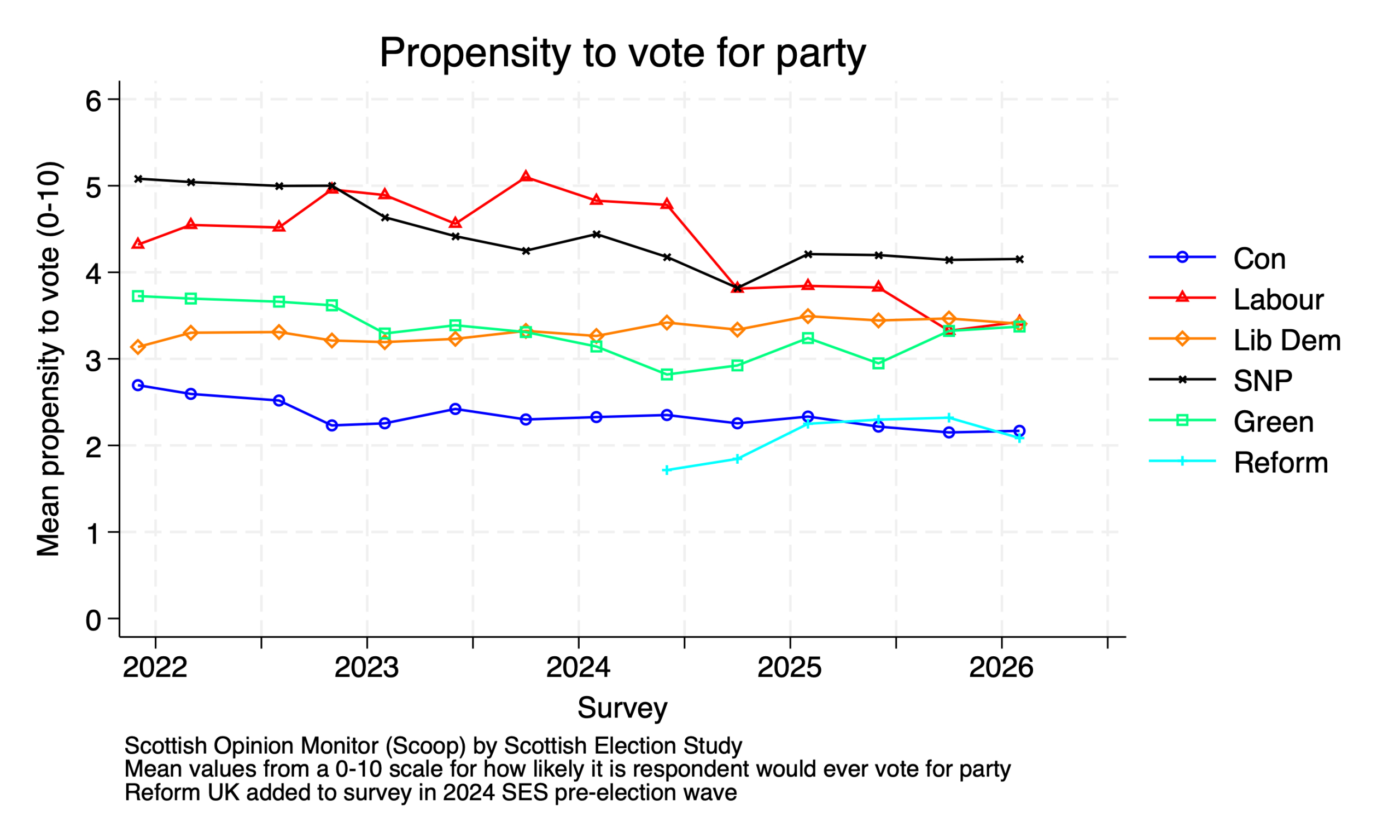
We are of course talking about Reform UK Scotland, who until this year had not acquired a leader or indeed much of a policy platform. We have written at length about Reform UK support in Scotland, noting that the party is fulfilling electoral demand for a “full fat” right wing populist competitor. They very quickly emerged as a force in Scotland after the 2024 General Election and may well finish second in May. They are, however, regarded just as negatively as the Conservatives, with around two thirds of our respondents at any given time indicating in “propensity to vote” (PTV) questions that they would never consider casting a ballot for the party. This negative polarisation could, as observed in recent by-elections in England and Wales, work against the party via tactical voting.
Figure 6 shows the simple average score for each party on the 0-10 PTV question in every SES survey since December 2021. Labour are the biggest losers on this metric, having gained ground to overtake the SNP in the run-up to the 2024 general election, peaking at an average of 5 in late 2023 as the nationalists lost ground. The SNP regained their advantage on this question virtually by default from Labour immediately after the General Election. The party now sit between 3 and 4 with the Scottish Greens and the Scottish Lib Dems. However, mirroring the Scottish Government’s job approval, the SNP merely stabilised after Swinney took over rather than bouncing back to their previous average of 5. The big takeaway from this is that no party can really claim to have broad appeal across the electorate, with the 2021 election’s top three parties all losing ground over this session of Parliament.
This is reflected in actual vote intentions. Figures 7 and 8 show the Scoop constituency and list vote intention trackers. Readers of this blog will likely already be aware of the rough trajectory of party support over the last five years. Scottish Labour’s rise and fall and Reform’s rapid emergence as a contender last year are obviously the most politically consequential developments here. The Scottish Greens’ steady rise is also notable, with the party now clearly in the hunt for second place on this list ballot.
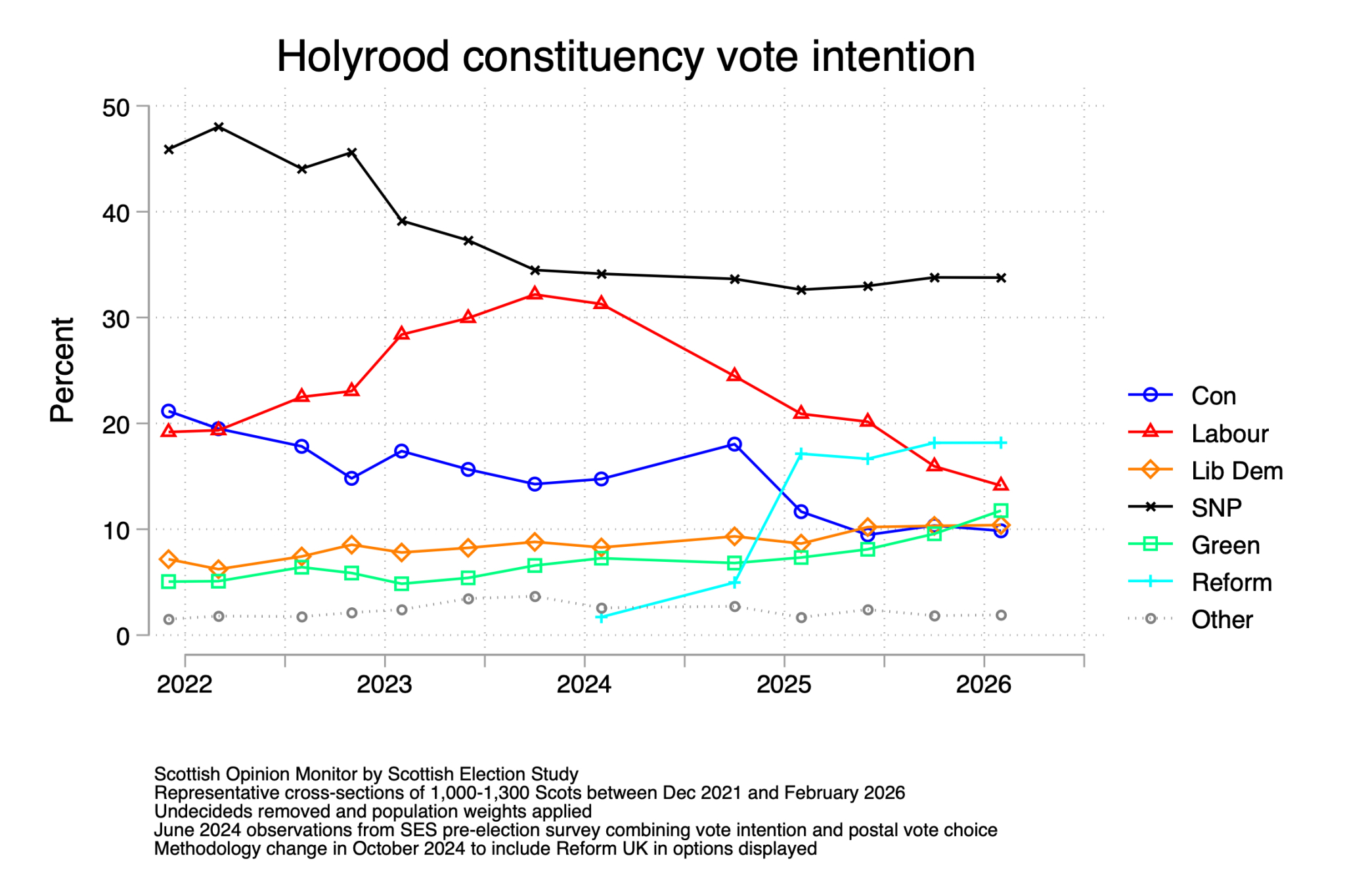
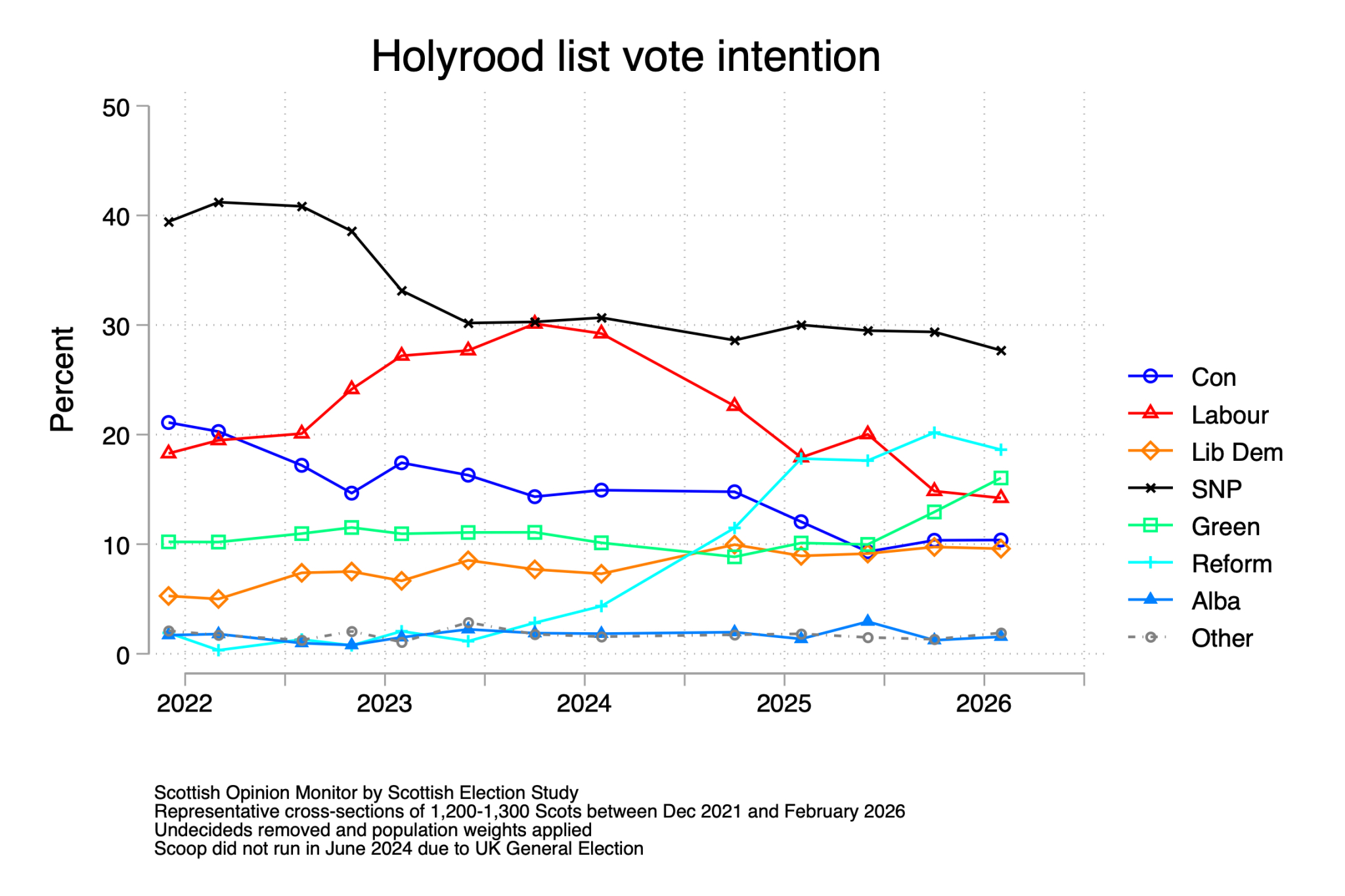
But the most remarkable thing about these trends is that the incumbent governing party has lost a third of its vote share and still seems on track to win at a canter. The party will likely record its lowest Holyrood vote since its first ever victory in 2007, a single-seat plurality achieved with 32.9% in constituencies and 31% on the list. Voters have become more accustomed to the electoral system in the years since, and there is now a much bigger gap between SNP constituency and list performance with most of that benefitting the Scottish Greens. But this only helps at the margins.
While Anas Sarwar fighting a “presidential” style campaign focused on the SNP’s record as a long-term incumbent is probably the right thing to do strategically, it looks like it won’t stop the nationalists for two big, closely related reasons. Firstly, most pro-independence Scots will still vote for the SNP – they may not love the nationalists as they once did, but they trust the SNP to stand up for Scotland’s interests within the current constitutional arrangement and, of course, would ultimately prefer to abandon these arrangements altogether. Two thirds of one half the electorate make one third overall. Secondly, the emergence of Reform UK at the same time as cross-border contamination tanking Scottish Labour (and the Conservatives’) prospects means the SNP’s opponents are even more fragmented than before. Figure 9 shows constituency vote intention trends for pro- and anti-independence voters since 2021. This graph starkly illustrates the party’s residual advantage and the difficulties faced by their pro-union opponents. Although constitutionally-aligned voting behaviour likely peaked in 2021, independence remains a powerful polarising force in Scottish electoral politics.
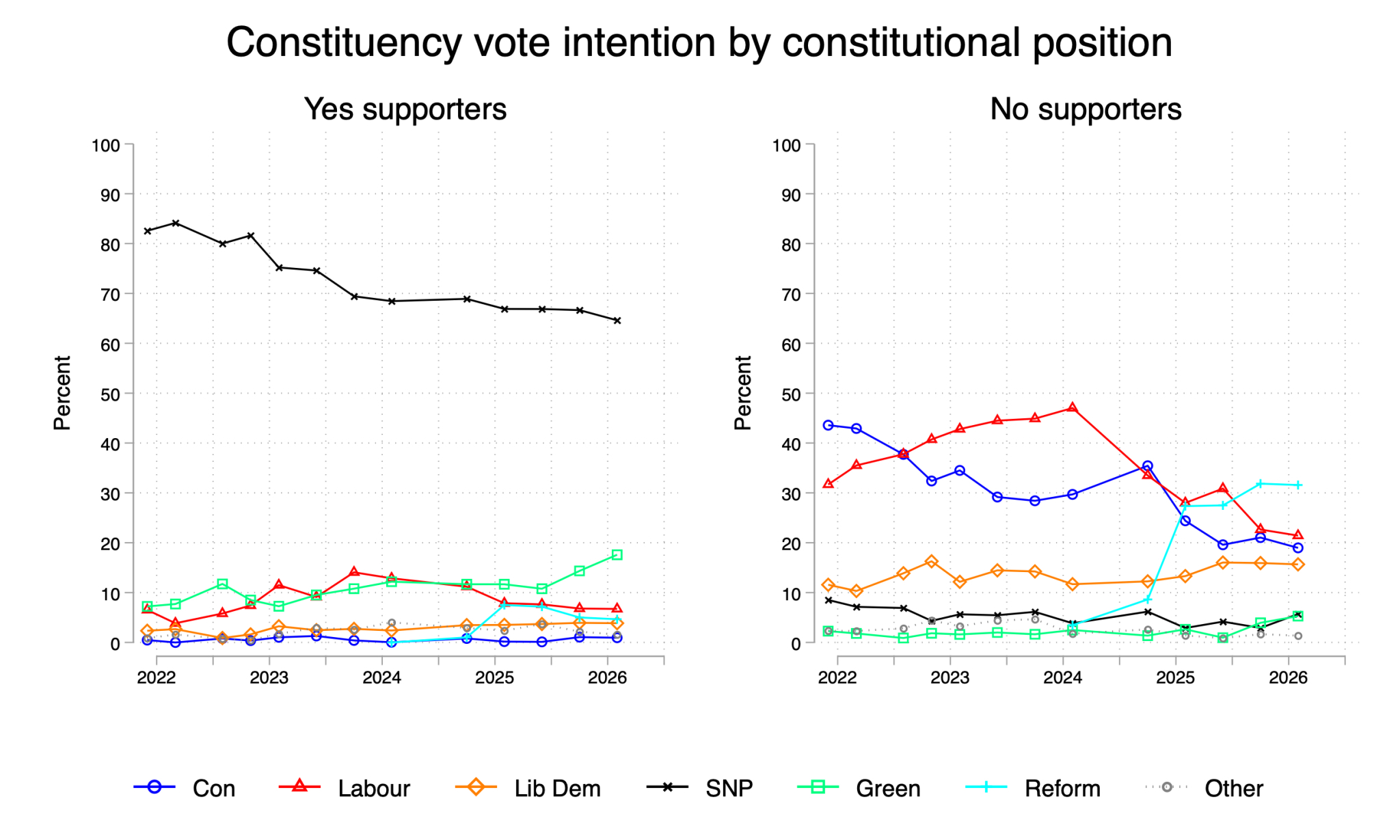
The risk for the SNP is that this election echoes Labour’s “loveless landslide” at the 2024 UK General Election: buoyed by the vagaries of the electoral system and a fragmented opposition, a centre-left party convincingly wins a low-turnout contest as the least unpopular option amid economic stagnation and international uncertainty. The SNP have to some extent “played the hits” to their left-leaning pro-indy base, while various expansionary manifesto pledges may prove challenging to implement as the fiscal environment continues to tighten. They are unlikely to lose support as quickly as the UK Labour government, but continued stagnation in living standards could further erode their support as an incumbent approaching a third decade in power.
Then again, as ever, much depends on developments in the rest of the UK. A Reform victory in 2029 or a hung parliament with the nationalists as kingmakers could once again scramble the political terrain – with a second independence referendum perhaps thrown into the bargain.
Indy mix
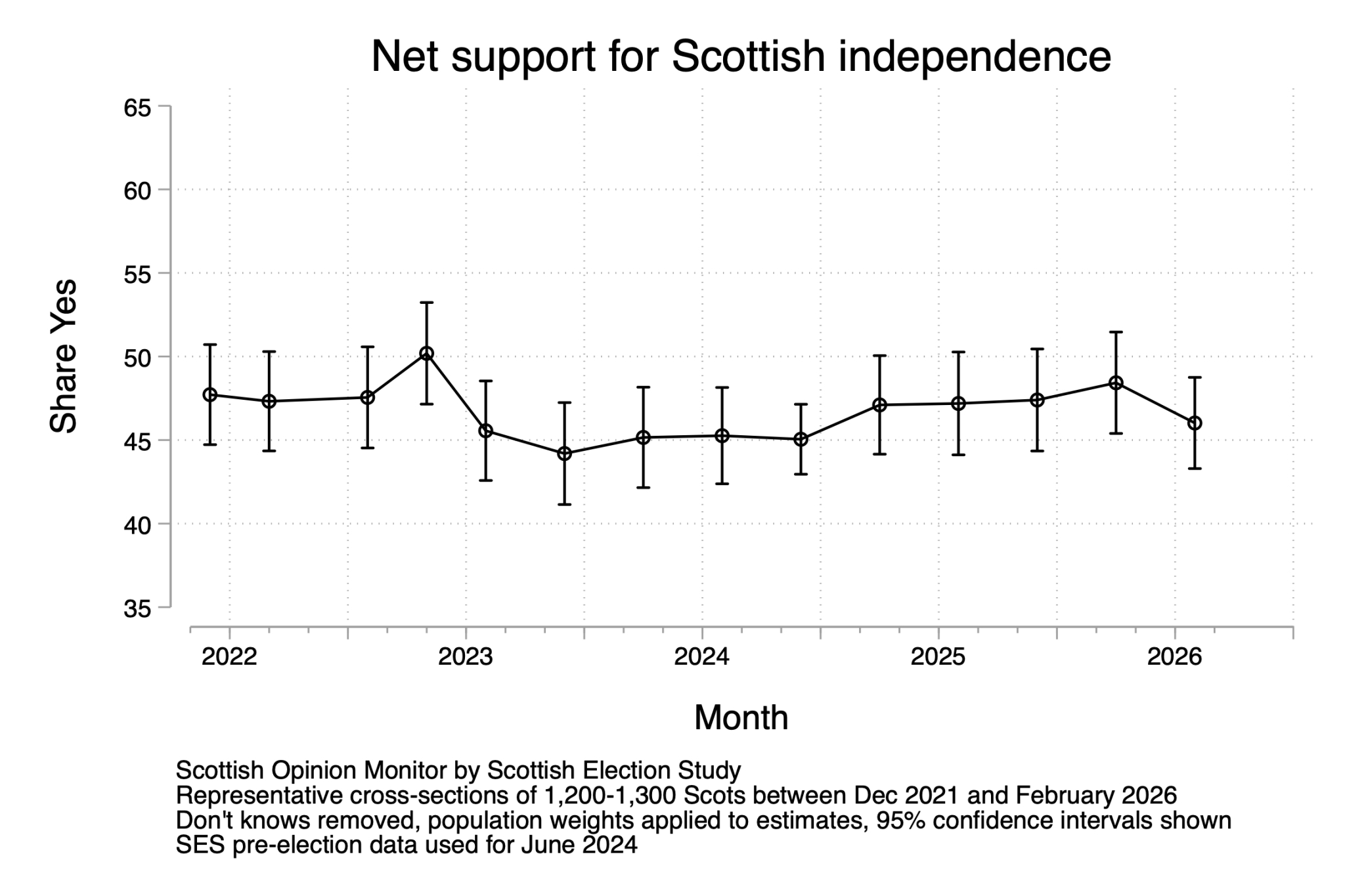
On that note, while the constitutional question has slipped down the agenda in recent years, the continued durability of support for independence itself also partly explains continued SNP electoral strength. Figure 10 shows the (non-) trend in Yes vs. No independence support since 2021. Despite domestic and international turmoil and massive shifts in the political landscape since 2014, Scots remain split in roughly the same way they did during the independence referendum. No retains a slight edge, but the fact that nearly half of Scots at any given time would prefer the country to leave the United Kingdom is itself remarkable. While this is now the norm, it had been widely expected that Labour’s return to power at Westminster would make at least some dent in support for independence. The Scoop data demonstrates, essentially, that it made no difference whatsoever.
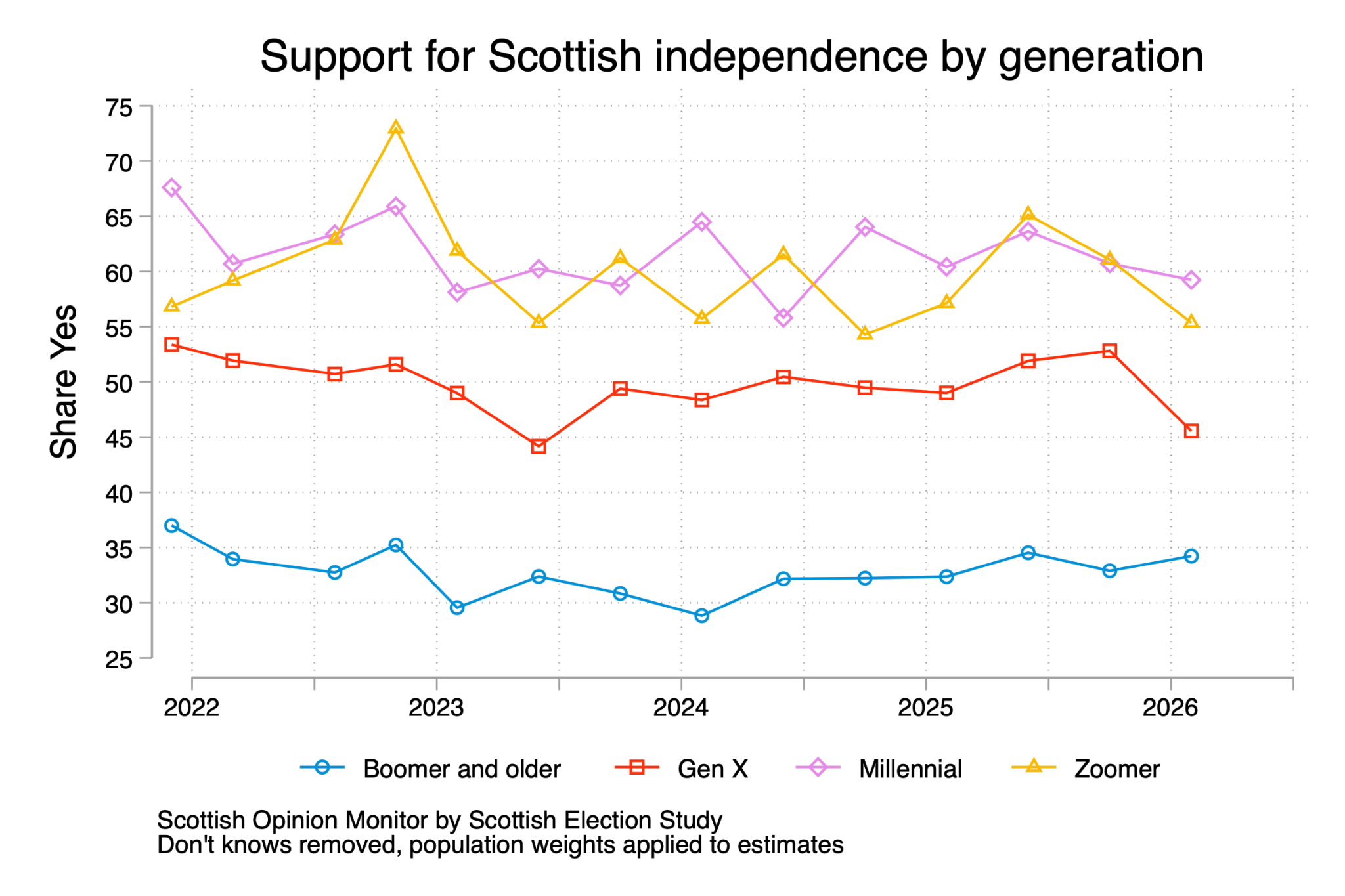
It is well established that support for independence is structured by age, and there is so far little systematic evidence that younger voters are changing their mind as they get older. Figure 11 shows how age polarisation on independence has evolved over the course of the last five years, with no major change in how the four voting-age generational cohorts break on the question. Those born before 1965 remain roughly 2:1 against independence, those born after 1980 are solidly in favour and those in between are evenly split. There is a bit more volatility among the two youngest cohorts, and the February 2026 Scoop saw a modest overall decrease in support (likely due to international events), but the age gradient of Yes support is still very steep.
The big question for this parliament, given the highly unpredictable 2029 General Election will take place at around the halfway mark, is the role constitutional politics will play. If as appears likely there continues to be a pro-independence majority at Holyrood after May the 7th, the Westminster result could prove to be a crucial moment in Scotland’s constitutional future.